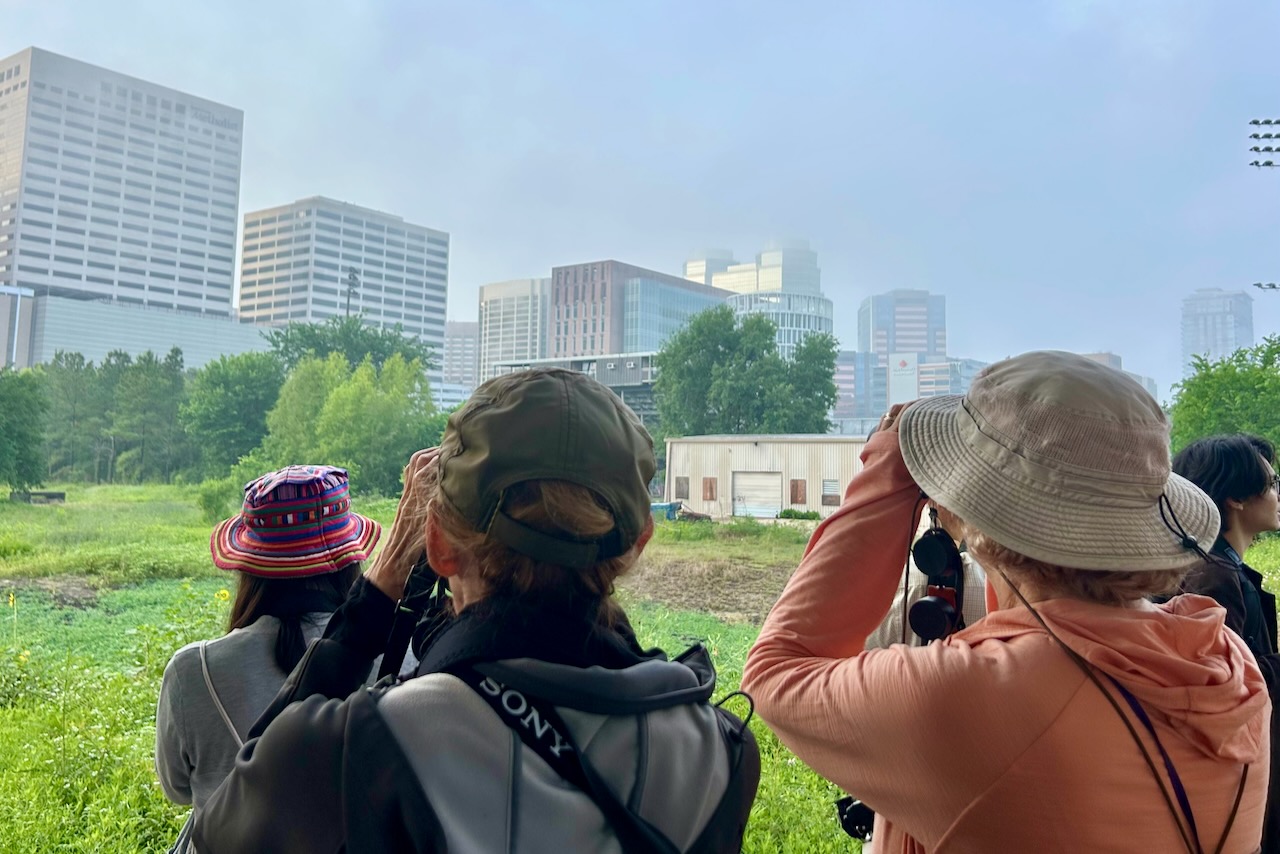
Houstonians gather in the ongoing Harris Gully restoration project to birdwatch in observance of Earth Day. Photo by Sophia Lannie.
April 22 marked Earth day, a date set aside to celebrate the natural world and efforts to protect it.
The United Nations has named climate change as the “defining crisis of our time,” but they say there is a path forward if people learn and work together to protect the Earth.
As Houston continues to grow, local conservation groups are working to restore small pieces of the region’s native habitat — while also introducing more people to the outdoors.
Last month, Earth Day events across Houston took place to try and increase engagement and education of environmental stewardship.
One of these events was a birding “big sit,” where members of the Houston community gathered to birdwatch for an entire day in the Harris Gully.
The Harris Gully is a restoration project led by the Lynn R. Lowry Arboretum on the campus of Rice University.
Cassidy Johnson, director of the arboretum, said they are trying to bring back Houston’s historic ecosystems: the coastal prairie, post-oak savannah, and wetlands.
“Houston used to be dotted with wetlands and wetlands are rapidly disappearing in Texas, and so we thought we’d, you know, do a little bit of our part to try and bring part of that ecosystem back” she said.
The work the arboretum has done to restore Houston’s natural ecosystems has not gone unnoticed.
Robert Rogillio, a Houston retiree, comes to birdwatch in the Gully often, and said he has noticed the changes and appreciates the arboretum for what they have done for habitat conservation and education.
“They’ve made a lot of changes here to attract the birds, and it’s very exciting. It’s a good place to come if you want to learn about birds.”
The arboretum’s restoration efforts do not just benefit the environment, they benefit us, Johnson said.
“People forget how connected we are to nature and how much we need it. So it’s kind of hard to get out in Houston to experience nature because we’re just a big, giant city. So we’ve decided we’d just bring some nature home.”
At 7:30 a.m. every Tuesday, Rogillio visits this piece of nature at the Harris Gully to birdwatch, as he said the hobby has increased his wellbeing.
“I get a lot of things out of it,” he said. “It can be relaxing, very restorative, and also it can be very exciting, kind of like an adrenaline rush.”
To get more involved with birding, Rogillio became a member of the Houston Audubon Society, a nonprofit organization dedicated to the conservation of birds and wildlife habitats.
Jessi Malowitz, the development manager of individual giving at the Audubon, agrees with Rogelio and said birding is an activity with many benefits.
“Well, you know, birding is just, I feel like it’s the perfect hobby. It can go out in nature, it gets you a little bit of exercise. It brings you into a community of people who want to help each other and always want to be together,” she said.
Every year, the Audubon hosts a Birdathon, where teams of all ages and skill levels compete and collaborate to see as many birds as possible and fundraise for the organization’s conservation efforts.
This year, the Birdathon runs from April 11th to May 11th. Jesi Malowitz, the development manager of individual giving at the Audubon, said that event has helped increase engagement with birding and conservation within younger people.
“People think of birding as like an old person kind of thing but it’s just thrilling when young people are interested in it because it’s like you always want to bring more people because that’s how we’re going to save birds,” Malowitz said.
And it’s not just college students getting involved.
The Houston Audubon recently launched their “Birdathon for the Classroom” program where elementary schools are sent tools for bird identification and environmental education resources.
Malowitz said Birdathon for the Classroom is offered for free in order to provide equitable access and to try and increase engagement with conservation across many elementary students.
Malowitz said the efforts have worked: “Offering these programs at minimal cost or for free helps make it more accessible to people. We have had some letters from kiddos come in, saying what birds they saw and that you know, wanting to tell us all about everything that they saw. And that’s really exciting.”