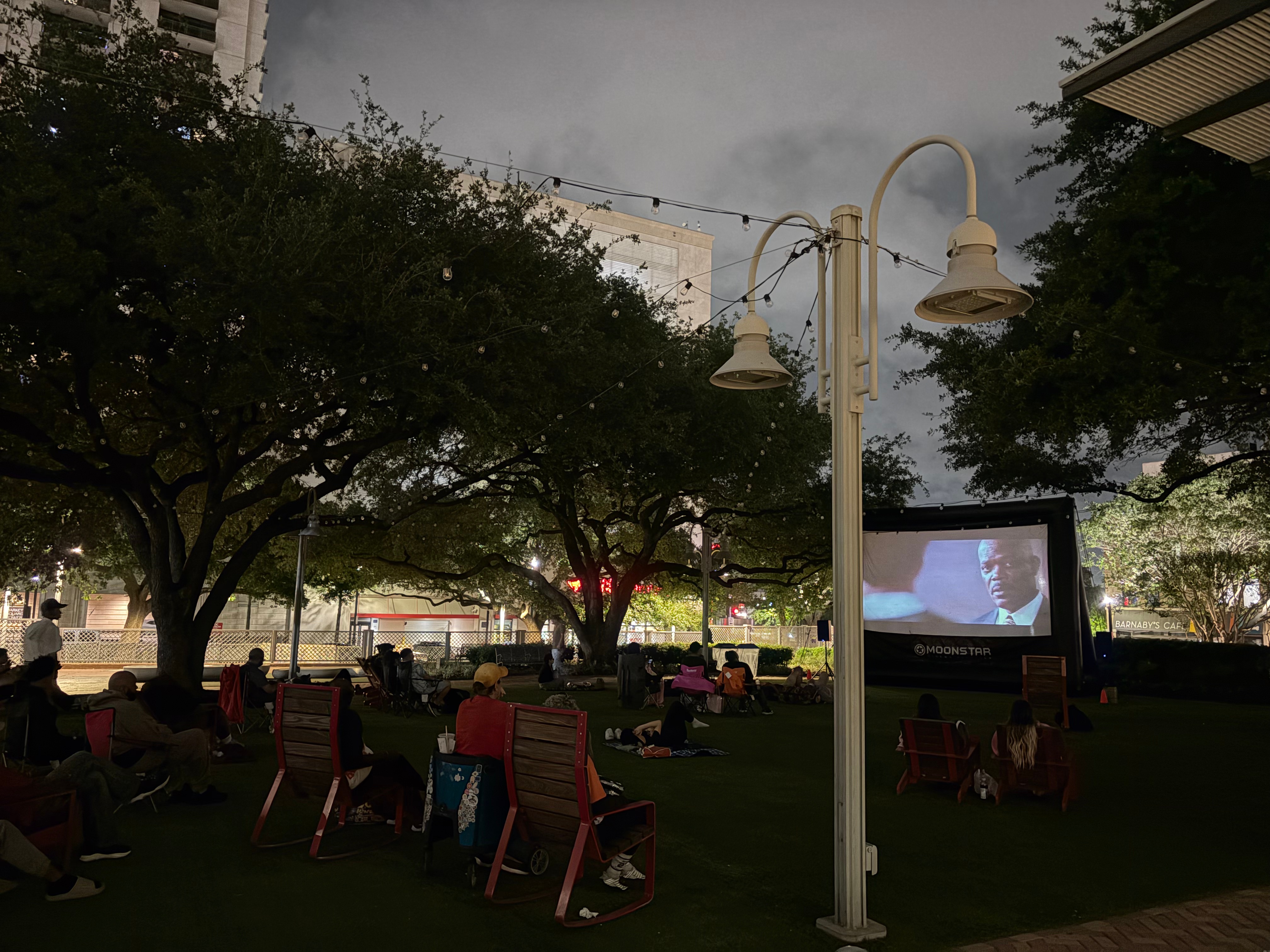
Audience members gather at Market Square Park for a free screening of Coach Carter on April 9, 2026, hosted by Downtown Houston+. Photo by Faith Choi for Houston Newsroom.
On a warm April evening, a group of 20 Houstonians sat on the grass fields of Market Place Park, watching a screening of the Samuel L. Jackson movie Coach Carter.
For some people, attending this event was not planned.
Camry Pula, one of the attendees, said she decided to stop by the event as she was passing by.
“I was Googling if there was a ticket price,” she said. “I really appreciate that it was just open to the public. I will definitely bring my friends next time.”
Others, like Lavonte Johnson, said he came to the event for something harder to find at home.
“There was a part that someone had said and it was kinda funny and the lady behind me repeated it,” he said. “It was refreshing to know we’re all enjoying this piece of art together.”
Free events like the Movies Under the Stars collection hosted by Downtown Houston+ aim to make art more accessible to the community.
At the Contemporary Arts Museum Houston, admission is always free. Accessibility is part of the mission, but it’s not always so simple.
Learning and Public Programs Manager YE Torres said reaching new audiences still remains a problem.
“The biggest challenges that we have is continuing to meet new audiences where they are and making sure there’s accessibility, especially as arts continue to be removed from schools.”
Torres said free programming plays an essential part in reaching audiences who might otherwise be left out.
“The reason why free programming is necessary is because no matter what, there’s somebody who’s going to come in every week several times a week that wouldn’t have come if it wasn’t free,” she said. “We just never know the ways art is going to move somebody.”
But supporting this access comes with issues.
Programming and Events Manager for Downtown Houston+ Amanda Marquez said some events include a small cost to keep programming going.
“Certain events can have ticketed aspects,” she said. “One of the events that we host is our Blanket Bingo Night and that has a 10 dollar participation fee, but all of those funds go back into funding park programming and into the downtown-wide parks in ways that we’re able to keep that programming continuous.”
Contemporary Arts Museum Teen Council and Tour Program Coordinator Jack Morillo said the question of accessibility reveals a deeper question.
“The question of why these public goods are free is an inversion of the more pertinent question of why would they cost money in the first place?”
Even when events are free, what can be shown and how widely it can be shared, is shaped by systems designed to protect artists.
Eden Burgess, an arts and culture attorney, said copyright is an important factor in this discussion.
“The purpose of copyright is to incentivize creators by ensuring them, to some extent, that their creation will always be theirs, unless they choose that it’s no longer theirs,” she said. “It’s quite intentional, not just about public art, of course, but just about any kind of reuse or expanding accessibility or an audience.”
Free public events don’t just make art available, they lower the barrier to entry.
But as institutions try to reach wider audiences while navigating funding and legal limits, accessibility remains an ongoing effort.