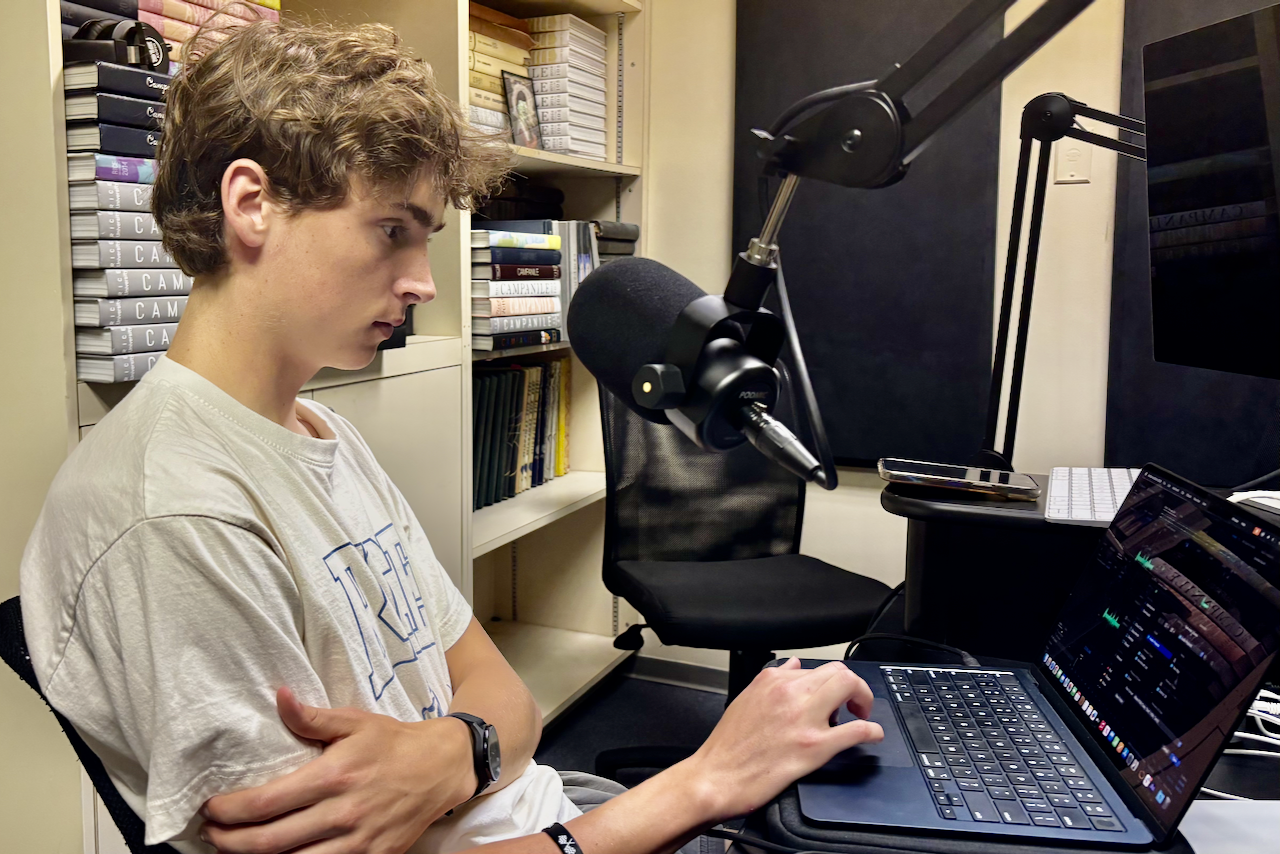
Mateo DeVries, a student journalist for Houston Newsroom, says his experience covering local politics has shown him that stories at the community level carry just as much importance as national coverage. Interview by Faith Choi.
Mateo DeVries is a sophomore at Rice University and a politics student journalist for Houston Newsroom.
DeVries said he entered his first major political event without knowing what to expect.
“I didn’t really know exactly how this whole reporting thing worked and I was kind of just flying into it with no idea how it was gonna work out,” he said.
He relied on a single email for permission to report at Talarico’s final campaign rally.
“I just got complete full access to the event, an event that over a thousand people came just to cheer and have the chance to hear him speak,” he said.
He said that moment reshaped how he understands reporting.
“Reporters have a certain standing. People respect reporters and they give them so much ability to see behind the scenes,” he says.
Instead of focusing on national headlines, he said he began paying attention to how political issues affect local communities more directly.
He said his reporting in Houston’s 18th congressional district revealed a gap in awareness, especially among students.
“I spent a good portion of time on UH‘s campus asking students, ‘are you familiar with these candidates… are you even aware that there is a runoff happening in a few weeks?’ And the majority said no,” he said.
That realization pushed him to think more critically about the role of local journalism.
“And so I really do believe that a fundamental concern here is just awareness,” he said. “I think the most important thing is to have an educated population.”
At the same time, DeVries confronts the challenge of maintaining objectivity. He said learning to separate personal opinions from reporting became one of the most difficult parts of the process.
“With audio journalism and with the responsibility to educate people that comes with that, you can’t include your own bias,” he said.
As the semester continues, he developed a new approach to reporting by leaning into curiosity and stepping outside his comfort zone.
“I’ve learned that I shouldn’t immediately think that people won’t be willing to talk to me because I’m not an experienced reporter… I should take more risks and that extrapolates to life as well. You shouldn’t create the answer in your head. You should actually go out and see if people are willing to do something,” he said.
Looking back, DeVries said local stories carry just as much weight as national ones, even if they receive less attention.
“I’ve really learned that the more local community based stories have as much value,” DeVries said, “stories about the more local leaders or politicians that don’t have name recognition at the household level, but make important decisions for the day to day lives of people in Houston.
“And those are politicians that are everywhere. They’re in my hometown, they’re in every city in the country,” he said.
For students interested in journalism or politics, his advice is simple.
“Take the risk. Email the person you don’t think will talk to you. See what happens,” he said. “I think you’ll find that people are much more receptive to you than you’d think.”