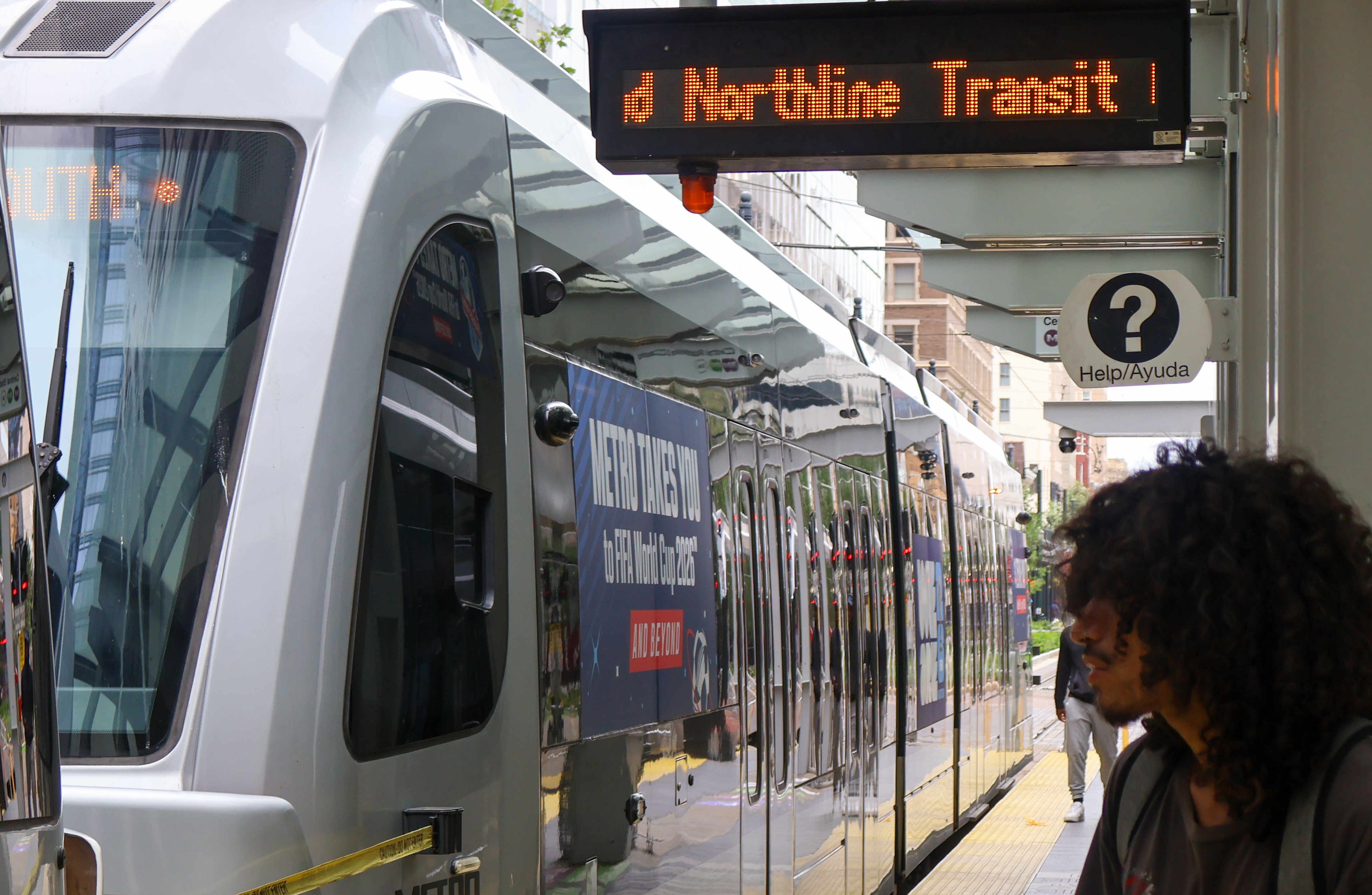
Riders wait for a METRORail train, decorated with posters reading “METRO TAKES YOU to FIFA World Cup 2026 AND BEYOND.” During the month of the World Cup, METRO services will operate on an expanded schedule with longer hours and more frequent arrivals. Photo by Paola Hoffman, Houston Newsroom.
As Houston prepares to host seven matches of the FIFA World Cup 2026, the city’s trains and buses are preparing to host fans from around the world during their commutes.
During the month of the World Cup, Houston’s METRORail, Park & Ride, Community Connector, and local bus services will operate for increased hours and with higher frequency.
Additionally, Anna Carpenter, the Director of Communications for METRO, said that the agency received federal grants to fund safety measures and operations during the World Cup.
The expanded METRO schedule went into effect on Sunday, June 7 and will continue through Saturday, July 11. Carpenter said she doesn’t think of the schedule as a change, but rather an adjustment tailored for the expected traffic.
“We’ve established a service that’s frequent, that’s reliable, based on the ridership that we have,” she said. “All that we’re doing is, for the expected visitors that are coming into our city over the next few weeks, we’re just going to increase the frequency of some of the most important routes that take you to the locations of the event and increase the hours.”
The METRORail Red Line and local buses will both see hours extended past midnight, with the Community Connector and Park & Ride services being offered seven days a week.
Carpenter said the Park & Ride adjustments are especially important: “We know that a lot of people daily commute from the region into downtown Houston, thousands, and they go in for work, they go in for school, and all of that brings cars into the area.
“And what we can do to minimize the disruption of our highways and our roads is to take the Park & Rides from outside of the loop into downtown.”
METRO riders said these public transit options make attending the World Cup more affordable.
Local resident Sicheng Chen said he’s planning to commute to the games using METRO services to save on parking.
“I’ve heard that the parking fee is gonna be around $100 or something, so I’m not planning to drive there,” he said. “And I think most people don’t want to pay $100 for parking.”
Alongside scheduling modifications, Carpenter said METRO has expanded its safety and security measures using funding from federal grants.
“You will see more fare inspectors on our service, as well as more, not only our officers, but we’ve also partnered with the Sheriff’s Department, HPD, and Constable’s offices so that they can help fill in the gaps during peak hours,” she said.
Carpenter said that three new police substations opened in the last year as part of these changes, with the most recent opening on Thursday, June 4 in Partnership Tower downtown. She said improvements were also made to METRO surveillance cameras and fare monitoring technology.
“We have increased our technology so that [fare inspectors] can actually verify fares on your cards and on your phones,” she said. This change comes after METRO switched to the RideMETRO Fare System in April.
Though the grants were specifically for World Cup developments, Carpenter said METRO has been focusing on investments that will still be impactful after the tournament is over, such as infrastructure and road repair.
“We call them legacy investments because they will remain even after the World Cup ends,” she said.
David Temple, a local resident who takes both METRORail and local buses for his daily, hour-long commute, said he’s seen METRO’s investments at work.
“I have noticed that they have people who are checking tickets here on the METRORail, and I think that kind of creates a little bit more security,” he said. “We have HPD, who greet people as they come in and are just kind of here for the ride.
“They don’t hassle anybody. They’re very nice, very polite. And I think that just kind of keeps behavior as society would expect.”
Not all riders said they share Temple’s impression of the METRO Police Department.
Steve Cummings, a frequent METRORail rider, said he isn’t always trusting of the fare inspection process, which he said was “a few people, yellow vests, going around, usually, I would say, profiling, or with good means, looking for proper fares.”
Cummings said this wariness doesn’t stop him from frequenting the Red Line.
“It’s the fastest way to get around,” he said.
Cummings said he was mostly unfamiliar with the METRO service expansion for the World Cup, but he was interested to see what it would bring.
“I would hope that means overclocked train schedules and possibly even just more consistent train schedules,” he said. “And hopefully it’s not too packed. Gonna look like New York in a few days.”
Carpenter says METRO is prepared for the influx of riders, including the crowds the agency is expecting on July 4th, where a World Cup game, Houston Astros game, and Freedom Over Texas event will overlap.
“We have prepared for a variety of scenarios, but there can always be a curve ball thrown, but we are confident that we have done it before,” Carpenter said. “The city has seen protests, the city has seen floods and several hurricanes and emergency situations, and we’ve always pulled through because we know how to pull our resources together.”